


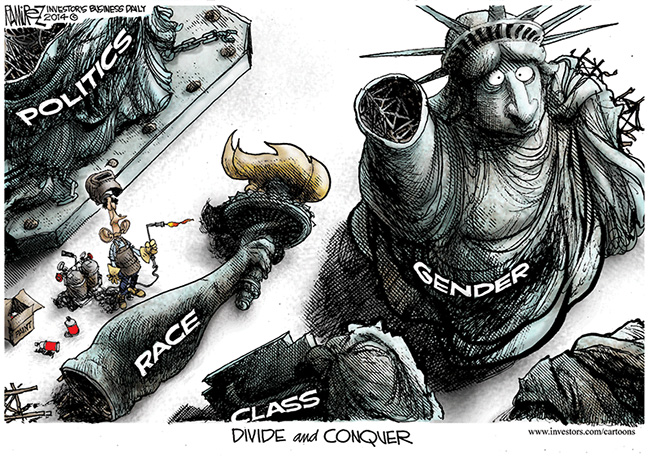
Mike Ramos goes after Jon Stewart
On Monday, Stewart blasted those defending former Ferguson Police Officer Darren Wilson after a grand jury decided not to indict him for fatally shooting 18-year-old Michael Brown. He went on to list several cases of police shootings throughout the country.
“I get what you’re saying there. This is an isolated incident, like the police shootings of Tamir Rice in Cleveland, or Dante Parker in San Bernardino County, or Kendreck McDade in Pasadena, or Armand Bennett in New Orleans, or John Crawford in… What time does (Stephen) Colbert start?” Stewart joked.
Stewart added: “The point is these shootings are clearly not a manifestation of systemic inequality and mistrust between the African-American community and the somehow always justified police-American community, but these are merely an unending, bizarrely similar series of isolated incidents.”
In his video, Ramos responded that Parker did not belong on that list as officers did not shoot him.
“They Tasered him after he had committed a burglary and he was attempting to assault a deputy sheriff – a sheriff who was losing that struggle and fighting for her life,” Ramos said.
Ramos also said Parker was under the influence of multiple drugs, which caused his death.
“I really believe we need to get our facts straight before making statements like that,” Ramos said.
Facts? What are facts when a narrative must be promoted? The whole #HandsUpDontShoot meme is an exercise in malicious racism.
Via Glenn Reynolds, Stewart’s “always justified police” was belied on the same day as the Garner Grand Jury decision.
ORANGEBURG, S.C. — A white police chief who fatally shot an unarmed black man in South Carolina in 2011 was charged with murder, and his lawyer accused prosecutors of taking advantage of national outrage toward police to get the indictment.
Richard Combs, the former police chief and sole officer in the small town of Eutawville, was indicted Wednesday, the same day a grand jury in New York decided against charging an officer in a chokehold death, and less than two weeks after there was no indictment in the fatal police shooting in Ferguson, Missouri. Those cases also involved white officers and unarmed black men and the decision not to charge the officers set off protests around the country.
No white guy ever dies at the hands of minority officers, and if they do the jury convicts them, right?
And cops never die when perps take their guns … never.
Obama never got involved, sent representatives to the funerals, nor made solemn comments in either the Kelly Thomas or Ryan Bonaminio cases.
Doesn’t fit his fundamental transformation agenda.
Obama told two back to back lies in his presser following the no-indictment announcement yesterday.
The first was that he wasn’t just going to talk, he was going to do something. Obama never acts, accept when he’s acting like he had nothing to do with whatever example of goverment overreach and/or incompetence and/or corruption has momentarily captured the limited attention of the public.
The second was something about making everybody feel secure that we’re all equal under the law –not just in theory but in day to day practice. That was the real howler, since his “actions” (rather, the actions of those authorized to act on his behalf, because Obama never does anything himself, lest the dupes start getting the right idea) have done more to to undermine the bedrock principle of equality under the law than any President before him. In theory as well as practice.
Never mind that more than 2 1/2 times as many whites are shot by cops than blacks*. Never mind that 99.9+% of all arrests are made without any undue violence**. Never mind that black are arrested for more murders than whites, despite being only about 1/6 the population.***
BECAUSE OF THE NARRATIVE!
* – In 2012, the most recent year for which data is available, 386 whites and 140 blacks were killed by police ( http://jimfishertruecrime.blogspot.com/2012/01/police-involved-shootings-2011-annual.html )
** – There were 12,408,899 arrests, and a total of 1,146 police-involved shootings in 2011, with a total of 607 deaths, the most recent data for either statistic.
*** – 4,741 whites arrested for murder in 2009, compared with 4,801 blacks, according to FBI stats. 2010 Census stats show whites are 72.4% of the US population, while blacks are 12.6%. ( http://www.census.gov/compendia/statab/2012/tables/12s0325.pdf and http://www2.census.gov/geo/maps/dc10_thematic/2010_Profile/2010_Profile_Map_United_States.pdf )
Seems like news, surely something Americans want, right?
WFB: Reports: Obama Mulling Sanctions on Israel
“Go easy on Iran,” say the Americans, “and hammer the hell out of the Jews.”
The problem is that blacks are a legally protected class.
The human version of an endangered species, as it were.
Just another example of how political correctness and the hierarchy of victimhood warp our perception of Real Life (TM).
Which is why the Justice Department won’t bother the investigate whether or not Zemir Begic civil rights were violated when he was beaten to death by “youths” last weekend.
By the way, how long until that particular euphemism becomes racissssst?
>The problem is that blacks are a legally protected class.<
so too with the gay run america
Obama backer, Democratic fundraiser Terry Bean charged in sexual abuse case
If our police were halfway competent, the claims of people like Stewart and Sharpton would be laughed at. This isn’t happening, and it’s not just because of media bias. For every person I know who’s been helped by the cops, I know another who’s been harassed by them. Hell, even our gracious host had the misfortune of living next to a member of the Thin Blue Gang.
I’ve defended the cops in the Ferguson case, because that’s the way the evidence led me. But I’m not going to pretend that our police forces are angels, or even that they’re very respectable. There’s a terrible, twisted sickness in cop culture. It’s encouraged by the unions, and neither the rank-and-file, the brass, or the elected officials are doing a damned thing to rein it in.
So yeah, while I wish the Stewarts and the Sharptons would just shut up and stop making things worse, I equally wish that the cops would get their shit together and start drumming out the worst among them. Then they might enjoy a much stronger claim to legitimacy and respectability, such that the charlatans really would be laughed off the stage.
While we’re at it, I’d also like a million-dollar sailboat, and I wouldn’t mind if my hair grew back.
>If our police were halfway competent<
oh my
BLACK FEMALE Police Sergeant Supervised Eric Garner’s Deadly Arrest
More statistics (2009) that are being utterly ignored:
90.8% of black murder victims were killed by black perpetrators. (Yawn)
7.3 % are killed by whites. (RACISM!!)
http://legalinsurrection.com/2012/03/inconvenient-narratives-in-the-martin-case/
http://www.fbi.gov/about-us/cjis/ucr/crime-in-the-u.s/2011/crime-in-the-u.s.-2011/tables/table-43
>Fourth, the technique of exercising power in traditional dictatorships contains a necessary element of improvisation. The mechanisms for wielding power are for the most part not established firmly, and there is considerable room for accident and for the arbitrary and unregulated application of power. Socially, psychologically, and physically, conditions still exist for the expression of some form of opposition. In short, there are many seams on the surface which can split apart before the entire power structure has managed to stabilize. Our system, on the other hand, has been developing in the Soviet Union for over sixty years, and for approximately thirty years in Eastern Europe; moreover, several of its long-established structural features are derived from Czarist absolutism. In terms of the physical aspects of power, this has led to the creation of such intricate and well-developed mechanisms for the direct and indirect manipulation of the entire population that, as a physical power base, it represents something radically new. At the same time, let us not forget that the system is made significantly more effective by state ownership and central direction of all the means of production. This gives the power structure an unprecedented and uncontrollable capacity to invest in itself (in the areas of the bureaucracy and the police, for example) and makes it easier for that structure, as the sole employer, to manipulate the day-to-day existence of all citizens.
Finally, if an atmosphere of revolutionary excitement, heroism, dedication, and boisterous violence on all sides characterizes classical dictatorships, then the last traces of such an atmosphere have vanished from the Soviet bloc. For some time now this bloc has ceased to be a kind of enclave, isolated from the rest of the developed world and immune to processes occurring in it. To the contrary, the Soviet bloc is an integral part of that larger world, and it shares and shapes the world’s destiny. This means in concrete terms that the hierarchy of values existing in the developed countries of the West has, in essence, appeared in our society (the long period of co-existence with the West has only hastened this process). In other words, what we have here is simply another form of the consumer and industrial society, with all its concomitant social, intellectual, and psychological consequences. It is impossible to understand the nature of power in our system properly without taking this into account.
The profound difference between our system—in terms of the nature of power—and what we traditionally understand by dictatorship, a difference I hope is clear even from this quite superficial comparison, has caused me to search for some term appropriate for our system, purely for the purposes of this essay. If I refer to it henceforth as a “post-totalitarian” system, I am fully aware that this is perhaps not the most precise term, but I am unable to think of a better one. I do not wish to imply by the prefix “post” that the system is no longer totalitarian; on the contrary, I mean that it is totalitarian in a way fundamentally different from classical dictatorships, different from totalitarianism as we usually understand it.
The circumstances I have mentioned, however, form only a circle of conditional factors and a kind of phenomenal framework for the actual composition of power in the post-totalitarian system, several aspects of which I shall now attempt to identify.
III
THE MANAGER of a fruit-and-vegetable shop places in his window, among the onions and carrots, the slogan: “Workers of the world, unite!” Why does he do it? What is he trying to communicate to the world? Is he genuinely enthusiastic about the idea of unity among the workers of the world? Is his enthusiasm so great that he feels an irrepressible impulse to acquaint the public with his ideals? Has he really given more than a moment’s thought to how such a unification might occur and what it would mean?
I think it can safely be assumed that the overwhelming majority of shopkeepers never think about the slogans they put in their windows, nor do they use them to express their real opinions. That poster was delivered to our greengrocer from the enterprise headquarters along with the onions and carrots. He put them all into the window simply because it has been done that way for years, because everyone does it, and because that is the way it has to be. If he were to refuse, there could be trouble. He could be reproached for not having the proper decoration in his window; someone might even accuse him of disloyalty. He does it because these things must be done if one is to get along in life. It is one of the thousands of details that guarantee him a relatively tranquil life “in harmony with society,” as they say.
Obviously the greengrocer is indifferent to the semantic content of the slogan on exhibit; he does not put the slogan in his window from any personal desire to acquaint the public with the ideal it expresses. This, of course, does not mean that his action has no motive or significance at all, or that the slogan communicates nothing to anyone. The slogan is really a sign, and as such it contains a subliminal but very definite message. Verbally, it might be expressed this way: “I, the greengrocer XY, live here and I know what I must do. I behave in the manner expected of me. I can be depended upon and am beyond reproach. I am obedient and therefore I have the right to be left in peace.” This message, of course, has an addressee: it is directed above, to the greengrocer’s superior, and at the same time it is a shield that protects the greengrocer from potential informers. The slogan’s real meaning, therefore, is rooted firmly in the greengrocer’s existence. It reflects his vital interests. But what are those vital interests?
Let us take note: if the greengrocer had been instructed to display the slogan “I am afraid and therefore unquestioningly obedient,” he would not be nearly as indifferent to its semantics, even though the statement would reflect the truth. The greengrocer would be embarrassed and ashamed to put such an unequivocal statement of his own degradation in the shop window, and quite naturally so, for he is a human being and thus has a sense of his own dignity. To overcome this complication, his expression of loyalty must take the form of a sign which, at least on its textual surface, indicates a level of disinterested conviction. It must allow the greengrocer to say, “What’s wrong with the workers of the world uniting?” Thus the sign helps the greengrocer to conceal from himself the low foundations of his obedience, at the same time concealing the low foundations of power. It hides them behind the facade of something high. And that something is ideology.
Ideology is a specious way of relating to the world. It offers human beings the illusion of an identity, of dignity, and of morality while making it easier for them to part with them. As the repository of something suprapersonal and objective, it enables people to deceive their conscience and conceal their true position and their inglorious modus vivendi, both from the world and from themselves. It is a very pragmatic but, at the same time, an apparently dignified way of legitimizing what is above, below, and on either side. It is directed toward people and toward God. It is a veil behind which human beings can hide their own fallen existence, their trivialization, and their adaptation to the status quo. It is an excuse that everyone can use, from the greengrocer, who conceals his fear of losing his job behind an alleged interest in the unification of the workers of the world, to the highest functionary, whose interest in staying in power can be cloaked in phrases about service to the working class. The primary excusatory function of ideology, therefore, is to provide people, both as victims and pillars of the post-totalitarian system, with the illusion that the system is in harmony with the human order and the order of the universe.
The smaller a dictatorship and the less stratified by modernization the society under it, the more directly the will of the dictator can be exercised. In other words, the dictator can employ more or less naked discipline, avoiding the complex processes of relating to the world and of self-justification which ideology involves. But the more complex the mechanisms of power become, the larger and more stratified the society they embrace, and the longer they have operated historically, the more individuals must be connected to them from outside, and the greater the importance attached to the ideological excuse. It acts as a kind of bridge between the regime and the people, across which the regime approaches the people and the people approach the regime. This explains why ideology plays such an important role in the post-totalitarian system: that complex machinery of units, hierarchies, transmission belts, and indirect instruments of manipulation which ensure in countless ways the integrity of the regime, leaving nothing to chance, would be quite simply unthinkable without ideology acting as its all-embracing excuse and as the excuse for each of its parts.
IV
BETWEEN the aims of the post-totalitarian system and the aims of life there is a yawning abyss: while life, in its essence, moves toward plurality, diversity, independent self-constitution, and self organization, in short, toward the fulfillment of its own freedom, the post-totalitarian system demands conformity, uniformity, and discipline. While life ever strives to create new and improbable structures, the post-totalitarian system contrives to force life into its most probable states. The aims of the system reveal its most essential characteristic to be introversion, a movement toward being ever more completely and unreservedly itself, which means that the radius of its influence is continually widening as well. This system serves people only to the extent necessary to ensure that people will serve it. Anything beyond this, that is to say, anything which leads people to overstep their predetermined roles is regarded by the system as an attack upon itself. And in this respect it is correct: every instance of such transgression is a genuine denial of the system. It can be said, therefore, that the inner aim of the post-totalitarian system is not mere preservation of power in the hands of a ruling clique, as appears to be the case at first sight. Rather, the social phenomenon of self-preservation is subordinated to something higher, to a kind of blind automatism which drives the system. No matter what position individuals hold in the hierarchy of power, they are not considered by the system to be worth anything in themselves, but only as things intended to fuel and serve this automatism. For this reason, an individual’s desire for power is admissible only in so far as its direction coincides with the direction of the automatism of the system.
Ideology, in creating a bridge of excuses between the system and the individual, spans the abyss between the aims of the system and the aims of life. It pretends that the requirements of the system derive from the requirements of life. It is a world of appearances trying to pass for reality.
The post-totalitarian system touches people at every step, but it does so with its ideological gloves on. This is why life in the system is so thoroughly permeated with hypocrisy and lies: government by bureaucracy is called popular government; the working class is enslaved in the name of the working class; the complete degradation of the individual is presented as his ultimate liberation; depriving people of information is called making it available; the use of power to manipulate is called the public control of power, and the arbitrary abuse of power is called observing the legal code; the repression of culture is called its development; the expansion of imperial influence is presented as support for the oppressed; the lack of free expression becomes the highest form of freedom; farcical elections become the highest form of democracy; banning independent thought becomes the most scientific of world views; military occupation becomes fraternal assistance. Because the regime is captive to its own lies, it must falsify everything. It falsifies the past. It falsifies the present, and it falsifies the future. It falsifies statistics. It pretends not to possess an omnipotent and unprincipled police apparatus. It pretends to respect human rights. It pretends to persecute no one. It pretends to fear nothing. It pretends to pretend nothing.
Individuals need not believe all these mystifications, but they must behave as though they did, or they must at least tolerate them in silence, or get along well with those who work with them. For this reason, however, they must live within a lie. They need not accept the lie. It is enough for them to have accepted their life with it and in it. For by this very fact, individuals confirm the system, fulfill the system, make the system, are the system.
V
WE HAVE seen that the real meaning of the greengrocer’s slogan has nothing to do with what the text of the slogan actually says. Even so, this real meaning is quite clear and generally comprehensible because the code is so familiar: the greengrocer declares his loyalty (and he can do no other if his declaration is to be accepted) in the only way the regime is capable of hearing; that is, by accepting the prescribed ritual, by accepting appearances as reality, by accepting the given rules of the game. In doing so, however, he has himself become a player in the game, thus making it possible for the game to go on, for it to exist in the first place.
If ideology was originally a bridge between the system and the individual as an individual, then the moment he steps on to this bridge it becomes at the same time a bridge between the system and the individual as a component of the system. That is, if ideology originally facilitated (by acting outwardly) the constitution of power by serving as a psychological excuse, then from the moment that excuse is accepted, it constitutes power inwardly, becoming an active component of that power. It begins to function as the principal instrument of ritual communication within the system of power.
The whole power structure (and we have already discussed its physical articulation) could not exist at all if there were not a certain metaphysical order binding all its components together, interconnecting them and subordinating them to a uniform method of accountability, supplying the combined operation of all these components with rules of the game, that is, with certain regulations, limitations, and legalities. This metaphysical order is fundamental to, and standard throughout, the entire power structure; it integrates its communication system and makes possible the internal exchange and transfer of information and instructions. It is rather like a collection of traffic signals and directional signs, giving the process shape and structure. This metaphysical order guarantees the inner coherence of the totalitarian power structure. It is the glue holding it together, its binding principle, the instrument of its discipline. Without this glue the structure as a totalitarian structure would vanish; it would disintegrate into individual atoms chaotically colliding with one another in their unregulated particular interests and inclinations. The entire pyramid of totalitarian power, deprived of the element that binds it together, would collapse in upon itself, as it were, in a kind of material implosion.
As the interpretation of reality by the power structure, ideology is always subordinated ultimately to the interests of the structure. Therefore, it has a natural tendency to disengage itself from reality, to create a world of appearances, to become ritual. In societies where there is public competition for power and therefore public control of that power, there also exists quite naturally public control of the way that power legitimates itself ideologically. Consequently, in such conditions there are always certain correctives that effectively prevent ideology from abandoning reality altogether. Under totalitarianism, however, these correctives disappear, and thus there is nothing to prevent ideology from becoming more and more removed from reality, gradually turning into what it has already become in the post-totalitarian system: a world of appearances, a mere ritual, a formalized language deprived of semantic contact with reality and transformed into a system of ritual signs that replace reality with pseudo-reality.
Yet, as we have seen, ideology becomes at the same time an increasingly important component of power, a pillar providing it with both excusatory legitimacy and an inner coherence. As this aspect grows in importance, and as it gradually loses touch with reality, it acquires a peculiar but very real strength. It becomes reality itself, albeit a reality altogether self-contained, one that on certain levels (chiefly inside the power structure) may have even greater weight than reality as such. Increasingly, the virtuosity of the ritual becomes more important than the reality hidden behind it. The significance of phenomena no longer derives from the phenomena themselves, but from their locus as concepts in the ideological context. Reality does not shape theory, but rather the reverse. Thus power gradually draws closer to ideology than it does to reality; it draws its strength from theory and becomes entirely dependent on it. This inevitably leads, of course, to a paradoxical result: rather than theory, or rather ideology, serving power, power begins to serve ideology. It is as though ideology had appropriated power from power, as though it had become dictator itself. It then appears that theory itself, ritual itself, ideology itself, makes decisions that affect people, and not the other way around.
If ideology is the principal guarantee of the inner consistency of power, it becomes at the same time an increasingly important guarantee of its continuity. Whereas succession to power in classical dictatorship is always a rather complicated affair (the pretenders having nothing to give their claims reasonable legitimacy, thereby forcing them always to resort to confrontations of naked power), in the post-totalitarian system power is passed on from person to person, from clique to clique, and from generation to generation in an essentially more regular fashion. In the selection of pretenders, a new “king-maker” takes part: it is ritual legitimation, the ability to rely on ritual, to fulfill it and use it, to allow oneself, as it were, to be borne aloft by it. Naturally, power struggles exist in the post-totalitarian system as well, and most of them are far more brutal than in an open society, for the struggle is not open, regulated by democratic rules, and subject to public control, but hidden behind the scenes. (It is difficult to recall a single instance in which the First Secretary of a ruling Communist Party has been replaced without the various military and security forces being placed at least on alert.) This struggle, however, can never (as it can in classical dictatorships) threaten the very essence of the system and its continuity. At most it will shake up the power structure, which will recover quickly precisely because the binding substance—ideology—remains undisturbed. No matter who is replaced by whom, succession is only possible against the backdrop and within the framework of a common ritual. It can never take place by denying that ritual.
Because of this dictatorship of the ritual, however, power becomes clearly anonymous. Individuals are almost dissolved in the ritual. They allow themselves to be swept along by it and frequently it seems as though ritual alone carries people from obscurity into the light of power. Is it not characteristic of the post-totalitarian system that, on all levels of the power hierarchy, individuals are increasingly being pushed aside by faceless people, puppets, those uniformed flunkeys of the rituals and routines of power?
The automatic operation of a power structure thus dehumanized and made anonymous is a feature of the fundamental automatism of this system. It would seem that it is precisely the diktats of this automatism which select people lacking individual will for the power structure, that it is precisely the diktat of the empty phrase which summons to power people who use empty phrases as the best guarantee that the automatism of the post-totalitarian system will continue.
Western Sovietologists often exaggerate the role of individuals in the post-totalitarian system and overlook the fact that the ruling figures, despite the immense power they possess through the centralized structure of power, are often no more than blind executors of the system’s own internal laws-laws they themselves never can, and never do, reflect upon. In any case, experience has taught us again and again that this automatism is far more powerful than the will of any individual; and should someone possess a more independent will, he must conceal it behind a ritually anonymous mask in order to have an opportunity to enter the power hierarchy at all. And when the individual finally gains a place there and tries to make his will felt within it, that automatism, with its enormous inertia, will triumph sooner or later, and either the individual will be ejected by the power structure like a foreign organism, or he will be compelled to resign his individuality gradually, once again blending with the automatism and becoming its servant, almost indistinguishable from those who preceded him and those who will follow. (Let us recall, for instance, the development of Husák or Gomukka.) The necessity of continually hiding behind and relating to ritual means that even the more enlightened members of the power structure are often obsessed with ideology. They are never able to plunge straight to the bottom of naked reality, and they always confuse it, in the final analysis, with ideological pseudo-reality. (In my opinion, one of the reasons the Dub?ek leadership lost control of the situation in 1968 was precisely because, in extreme situations and in final questions, its members were never capable of extricating themselves completely from the world of appearances.)
It can be said, therefore, that ideology, as that instrument of internal communication which assures the power structure of inner cohesion is, in the post-totalitarian system, some thing that transcends the physical aspects of power, something that dominates it to a considerable degree and, therefore, tends to assure its continuity as well. It is one of the pillars of the system’s external stability. This pillar, however, is built on a very unstable foundation. It is built on lies. It works only as long as people are willing to live within the lie.
<
link
dear g_d
Thrive
In any case, experience has taught us again and again that this automatism is far more powerful than the will of any individual; and should someone possess a more independent will, he must conceal it behind a ritually anonymous mask in order to have an opportunity to enter the power hierarchy at all. And when the individual finally gains a place there and tries to make his will felt within it, that automatism, with its enormous inertia, will triumph sooner or later, and either the individual will be ejected by the power structure like a foreign organism, or he will be compelled to resign his individuality gradually, once again blending with the automatism and becoming its servant, almost indistinguishable from those who preceded him and those who will follow.
Until The Whole World Hears
Jesu, Joy of Man’s Desiring Bach
Ave Maria
“…and the…”
Of course, all the other words were lies too.
[…] Ernst Schreiber points out, Blacks have been enjoying Endangered Species Status for many decades […]
via Glenn Reynolds, the quote I was reacting to from The Hill:
How Obama was able to say that with a straight face and not have his explode like Paul Freeman’s in Raiders of the Lost Ark, I’ll never know.
have his head explode
damnit
Andy McCarthy wrote about one aspect of a divide just a day ago or so.